Second SQMS Grant Aims to Scale Quantum Computing Platform
We leverage the interdisciplinary culture here at Northwestern; contributions from those researchers enable the materials science piece to be impactful at scale.”
— James Rondinelli
Walter Dill Scott Professor of Materials Science and Engineering
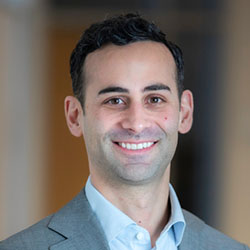 James Rondinelli
The first round of work conducted by the Superconducting Quantum Materials and Systems Center (SQMS) aimed to establish and demonstrate the bona fides of a new quantum computing platform. The grant that was announced on November 4 for a second round of SQMS, a multi-organizational effort funded through the U.S. Department of Energy, led by Fermi National Accelerator lab and tapping Northwestern researchers’ expertise, will scale it up.
James Rondinelli, a computational materials physicist who holds appointments as the Walter Dill Scott Professor of Materials Science and Engineering and in the Applied Physics Program, is Northwestern site principal investigator (PI) coordinating efforts among 10 research groups across two colleges on campus. He is the associate chair of materials science and engineering at Northwestern and is an executive committee member of the Institute for Quantum Information Research and Engineering (INQUIRE). Rondinelli was also recently named a Fellow of the Materials Research Society on November 17.
Bringing together more than 550 quantum experts from 36 institutions, including Northwestern, SQMS 1.0 established that researchers could integrate superconducting radio frequency cavities with two-dimensional transmons—originated by NU physics and astronomy Professor Jens Koch, Rondinelli’s predecessor as SQMS site PI and Deputy Director, and fellow INQUIRE executive committee member—to create qubits, which are circuit elements with multiple states of matter used in applications by technology companies like IBM and Righetti Computing.
"The uniqueness of our approach is to integrate transmons into novel cavity structures, forming hybrid architectures known as cavity-qudits, and to leverage these designs for quantum systems that surpass current state-of-the-art capabilities," says Rondinelli. "SQMS technologies capitalize on Fermilab’s high-quality superconducting radiofrequency (SRF) cavities—originally engineered for cutting-edge particle accelerator applications," he says. "SQMS 1.0 established the hybrid architecture as a viable direction. SQMS 2.0 is aimed at scaling that to many, many qubits."
Key goals of the next five years include:
- Build a 100+ qudit quantum processor. Develop a 3D cavity-based architecture with a computational space equivalent to approximately 500 two-level qubits, enabling unprecedented scalability and performance.
- Achieve a 10× reduction in errors through chip-level innovations. Advance novel processing techniques and materials to dramatically improve qubit coherence and reduce noise, leveraging SQMS breakthroughs in cavity design and leading-edge materials.
- Prototype a quantum data-center unit. Establish scalable cryogenic and microwave infrastructure as the foundation for future quantum networks and distributed quantum computing. Northwestern’s role in enabling that scaling will involve developing ultra-high-coherence spin times in the materials, understanding the best processing strategies to avoid decoherence (i.e. breaking apart), Rondinelli says. "We want really long lifetimes so that we can enable high-fidelity quantum links across multiple quantum systems housed in different cryogenic vessels," he says.
Hundreds of those qubits will need to be created, and Northwestern will participate in some of the fabrication of those materials; while at the same time, a large-scale cryogenics effort will be targeted at bringing on large-scale facilities to house the quantum computers, which Rondinelli says will not happen at NU, but it’s a major focus of Fermilab itself.
Of the 10 PIs at Northwestern participating in SQMS 2.0, seven will be part of the materials effort to establish the long coherence times, two are computer scientists developing the software part of the quantum computing piece, and one physics faculty member will work on the applications, Rondinelli says.
“They’re exceedingly critical in developing the compilers that will enable the quantum computing on the 3D qudit hardware,” he says of the computer scientists, while the physics end will “get to ultra-sensitive high-precision magnetometry, measurements of magnetic fields, using the hardware that’s being developed.”
Northwestern’s strengths will lend themselves to the new phase of the research in the materials effort, developing both microscopic understanding and exploiting characterization facilities in which the school is a leader, such as microscopy and fabrication capabilities, Rondinelli says. The latter “allows us to … understand at the atomic scale what’s causing the decoherence,” he says. “And then, given that understanding, we can propose processing or fabrication changes … that could occur to mitigate, whatever is causing the decoherence at the atomic or microstructural scales.”
That could mean a range of approaches, such as using a different etchant when preparing a substrate, or a different operating temperature for a particular process, or a reagent that doesn’t have chlorine or fluorine, Rondinelli says. “So you kind of change the process, once you understand what’s causing the decoherence—it could be impurities at the atomic scale or the local composition of the materials comprising the qubits. So that leverages decades of expertise in materials research and engineering as well as in applied physics that’s unique to Northwestern.”
The computer science department will provide a strong foundation for building out the algorithms and software stack the quantum computer will need to perform the operations required, Rondinelli says. “They’re experts in software part of it—the compliers which involve optimizing quantum circuits, mapping algorithms to hardware, and reducing error rates. We leverage the interdisciplinary culture here at Northwestern; contributions from those researchers enable the materials science piece to be impactful at scale,” he says.
Rondinelli’s own work involves modeling and simulating the behavior of materials at the atomic scale using “classical” quantum mechanical methods, including solids as well as molecules and their physical properties—electronic, magnetic and optical. “We take a more fundamental materials physics approach, trying to understand how different interactions give rise to those physical properties, macroscopically,” he says. “What’s relevant for the quantum part is that we work both on quantum materials and phenomena, including magnetism, ferroelectrics and other unusual unconventional phases of matter, as well as materials platforms for quantum information science and technology.” These correlated materials “often have strong electron-electron interactions that dominate their behavior, leading to emergent phenomena, whereas more conventional materials are predictive using independent electron approximations. Such properties include elasticity, hardness, and thermal conductivity.”
This integration in Rondinelli’s group bridges conventional materials design with emerging quantum materials. As such, Rondinelli is equipped to not only draw connections between what might be a useful material for an applied quantum technology but also be able to point out that some material systems are intrinsically quantum in nature, and these could be used instead of developing more sophisticated, scaled systems for sensing or computing.
“We work with lots of experimentalists. Our group is highly interdisciplinary in that way,” he says. “We work with other physicists, more card-carrying condensed matter physicists, who do low temperature transport. … Then, we work with materials engineers. We work with chemists who like to make new materials, and then we work with electrical engineers who are developing devices or circuitry to try to integrate those new materials. So we provide that bridge between the different groups, as well.”