2025
December 16, 2025 – from Chicago Quantum Exchange
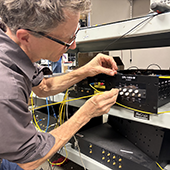
NuCrypt, an Illinois-based manufacturer of quantum optical instrumentation, has joined the CQE as a corporate partner.
December 12, 2025
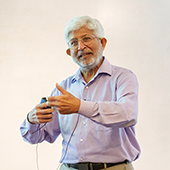
Professor Prem Kumar will provide guidance on the long-term strategy for NTT’s fundamental research in materials science, quantum science, and solid-state and optical science
December 10, 2025 – from Argonne National Laboratory
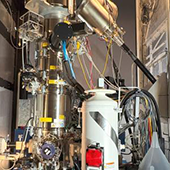
Researchers have discovered how to design and place single-photon sources at the atomic scale inside ultrathin 2D materials, lighting the path for future quantum innovations.
December 4, 2025 – from Fermilab
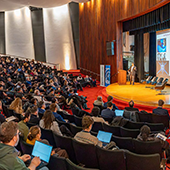
Fermilab is hosting a national symposium that brings together experts from across the quantum information science community. The event comes as the United States expands its leadership in quantum technology and underscores Fermilab’s increasing emphasis on QIS research.
November 26, 2025
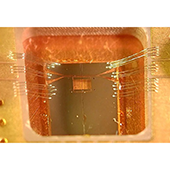
A promising method for connecting quantum devices on a chip is to use magnons, magnetic waves that move through materials and carry information. Recent research from a team led by Professor Mark Hersam found that a fragile magnetic material called vanadium tetracyanoethylene can be protected from atmospheric damage by coating it with an extremely thin layer of alumina.
November 24, 2025
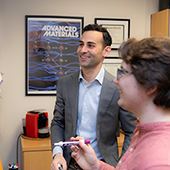
The first round of work conducted by the Superconducting Quantum Materials and Systems Center (SQMS) aimed to establish and demonstrate the bona fides of a new quantum computing platform. The grant that was announced on November 4 for a second round of SQMS, a multi-organizational effort funded through the U.S. Department of Energy, led by Fermi National Accelerator lab and tapping Northwestern researchers’ expertise, will scale it up.
November 19, 2025
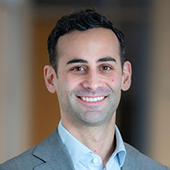
Northwestern Engineering’s James Rondinelli and Christopher Schuh have been selected to the class of 2026 Materials Research Society (MRS) Fellows.
November 4, 2025
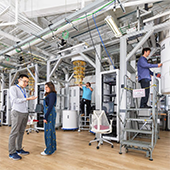
The U.S. Department of Energy Office of Science has renewed the Superconducting Quantum Materials and Systems Center (SQMS), hosted by Fermi National Accelerator Laboratory, with $125 million over the next five years to accelerate breakthroughs in quantum information science. The total planned funding is $125 million over five years, with $25 million in the first year and future funding contingent on congressional appropriations.

October 3, 2025
Quantum light sources often produce inconsistent or contaminated single photons, limiting the reliability of quantum technologies. This simple, scalable approach enables more precise, reliable photon sources essential for secure quantum communication and ultra-precise sensing.
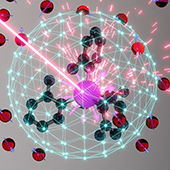
September 19, 2025 – from Chicago Quantum Exchange
New projects could lead to breakthroughs in computing, sensing and secure communications

September 3, 2025
NVIDIA code could help researchers tackle computationally demanding tasks hindering quantum research
August 26, 2025 – from Chicago Quantum Exchange
Anchored by the Chicago Quantum Summit, Midwest Quantum Week highlights strengths of the IL-WI-IN quantum ecosystem
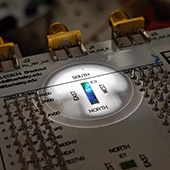
July 14, 2025
For the first time, scientists at Northwestern University, Boston University (BU) and University of California, Berkeley (UC Berkeley) have built a tiny photonic quantum system into a traditional electronic chip.
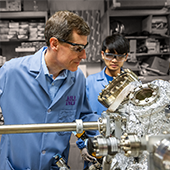
July 10, 2025
The field of quantum information science (QIS) relies heavily on physics—and many think about it in those terms—but materials science and chemistry are also critical to the success of quantum technologies like computing, sensing and communications, according to Mark Hersam, PhD, chair of the materials science and engineering department and director of the materials research center at Northwestern’s McCormick School of Engineering.
July 1, 2025
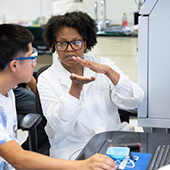
One program, Quantum Sensing Summer Program with NSF QuBBE, offers Chicago high schoolers two weeks of lab immersion.
June 12, 2025
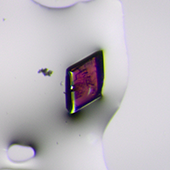
Just when scientists thought they knew everything about crystals, a Northwestern University and University of Wisconsin-Madison collaboration has uncovered a hidden secret.

June 10, 2025
Northwestern University chemist James Gaynor has been named a 2025 Beckman Young Instigator by the Arnold and Mabel Beckman Foundation.
Established in 1991, the Beckman Young Investigator Program supports the most promising young faculty members in the early stages of their academic careers in the chemical and life sciences. It is particularly designed to foster the invention of methods, instruments and materials to open new avenues of scientific research. Each awardee receives $600,000 in funding across four years.
June 5, 2025 – from Physics World
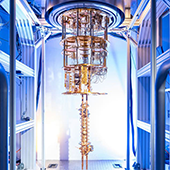
The US Superconducting Quantum Materials and Systems (SQMS) Center is betting on ultrahigh-quality-factor superconducting cavity technologies in its quest to develop scalable “qudit-based” quantum computing and communication architectures.
May 15, 2025
A research paper that demonstrated how quantum communications can be implemented using conventional fiber optic infrastructure--which went “viral” in both the mainstream and scientific news media last December--has led to a bevy of speaking engagements in India this year for co-author Prem Kumar, PhD, director of Northwestern’s Center for Photonic Communication and Computing and a professor of electrical and computer engineering.

January 23, 2025
While entangled photons hold incredible promise for quantum computing and communications, they have a major inherent disadvantage. After one use, they simply disappear.
But in a new study published in Physical Review Letters, Northwestern physicists propose a strategy to maintain communications in a constantly changing, unpredictable quantum network. By rebuilding these disappearing connections, the researchers found the network eventually settles into a stable — albeit different — state.