Symposium Panel Explores Present, Future Quantum Potential
What are the gaps between the capabilities of today’s quantum hardware and what potential use cases require? How can companies and other organizations handle the uncertain timeline from the current intermediate stage to a more disruptive generation of quantum computing? And how should quantum specialists and domain scientists work together for mutual benefit?
These questions and others were explored during a panel on “Quantum Computing Use Case Development” that brought together industry, government and university experts, moderated by Kate Smith, assistant professor of computer science at Northwestern, and held April 22 during the INQUIRE Quantum Innovation Symposium.
Juliette Peyronnet, US General Manager for the French company Alice & Bob, noted that in the past few years, the research community focused on noisy intermediate-scale quantum (NISQ) has been trying to extract value from the quantum algorithms developed to date. “And I think we all came to the conclusion that there is a lot of limitation to that,” she said. “We are all working very hard to build these logical qubits at a scale that becomes relevant for, first, scientific use, and then industrial use.”
Work is underway on both the hardware and software sides to achieve use cases for industry, said Heejeong Jeong, head of quantum computing US at Pasqal USA Inc., part of another French company. “To bring the real, tangible near-term value, we focus on the analog mode approach, while we are developing fault-tolerant quantum computing at the same time. But, in general, it might take some years from now before that FTQC generation is achieved,” she said.
Nikos Hardavellas, Northwestern professor of computer science and electrical and computer engineering, said that while fault tolerance should be the future goal, in the near term the field should focus resources on techniques like quantum error detection and mitigation. “There are lots of ways that we can address the fragility of the qubits that we have today,” he said, “while we’re waiting for technology to catch up and give us the large array of logical qubits that we will need for a fault-tolerant quantum system to address big problems.”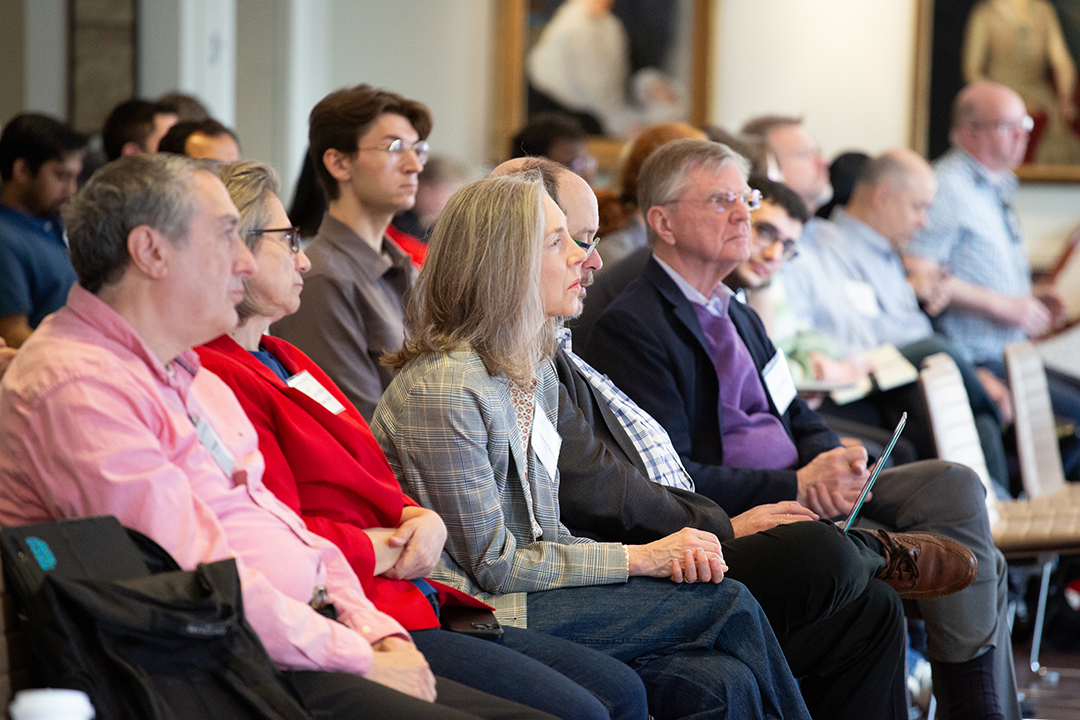
California-based PsiQuantum is working to solve challenges like fiber-to-chip coupling and handling cryogenics cost-effectively at large scale, said Aaron Fluitt, senior director for technology partnerships at the company, which is also an anchor tenant at the Illinois Quantum and Microelectronics Park. “It’s also, I think, creating some important new innovations that are helping us reach these scales more cost-effectively, and with a path to continue to drive down the cost of compute over time,” he said.
Laura Schulz, head of quantum innovation at the Argonne National Laboratory’s Leadership Computing Facility, said she’s heard discussions about needing to wait for vendors to build the hardware and software stack that achieves fault tolerance. But “if we wait too long to develop a cohesive software environment, because we wait for the quantum hardware to be there, it’ll be too late, and we’ll have problems. So the idea of getting started now, even in an imperfect space, it’s really important. … There may be some things we have to throw in the trash later, but it’s also going to help us understand how to build the next generation.”
In the meantime, how organizations approach the middle part of the quantum timeline depends upon their starting point, and they should think about a staged approach, Fluitt said.
While chemistry or materials science problems often scale in a way that taxes even large conventional supercomputers, “You probably don’t want to put that whole calculation on a quantum computer,” he said. “It would not be an efficient use of those resources. What you really want is to diagnose that system and understand where that very high level of fidelity is needed that a larger quantum computer will give you, and focus your resources there.” Organizations can then use conventional computing for the remainder of the problem, he added.
Building proof-of-concept for a given computing project is best handled with collaboration between quantum specialists and subject domain experts, Jeong said. “I think it’s complementary,” she said. “The domain side develops their knowledge by working with the quantum algorithm developer, and the quantum algorithm developer learns domain knowledge and how to implement their algorithm on the domain knowledge.”
Schulz recalled a past role in which she put quantum developers and application engineers in the same room to bridge their domains, which sometimes proved challenging despite their high level of respective expertise, and she expressed the hope that universities will provide spaces for such interdisciplinary collaborations. “Even if there are residencies for algorithm developers to hang out with biologists, or chemists, or whomever and establish this constant cross-pollination,” she said, “maybe it’s a good opportunity to look at our educational programs.”
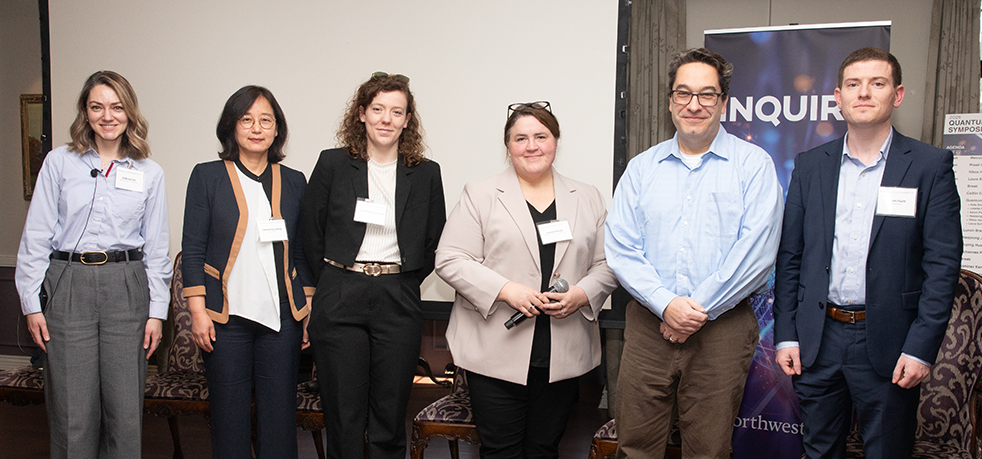
from left to right: Kate Smith, Heejeong Jeong, Juliette Peyronnet, Laura Schulz, Nikos Hardavellas, and Aaron Fluitt
Software engineers need to understand the use cases that subject domain experts need quantum to solve, to best to dedicate their resources to what matters the most in achieving them, Hardavellas said. “Without domain knowledge, I cannot do that. I have to treat everything the same” in importance and relevance, he said.
Fluitt expressed the hope that ideally, domain scientists will only need to learn enough to use quantum computing as a tool. “I don’t want to have to worry about the encoding or the error rates. I want to know, is this going to get me closer to the chemical insight I am seeking?” he said. “I don’t think we’re all the way there yet. … Realistically, in the short term, scientists who want to explore this probably need to learn a little bit of quantum.”
While Schulz mostly agreed with that, she thinks it will remain helpful for domain scientists to have a general understanding of the broad computational capabilities. “What I want to be able to do is understand what sort of computational behavior does quantum offer that I can apply to my problem” she said. “There’s going to be this cognizance of the computing behaviors that you can apply as your toolbox, as part of your arsenal, to the problems that you want to solve, but I don’t want domain scientists to need intimate knowledge of the underlying systems, and I definitely don’t want them programming down to the qubits, or optimizing at that level.”
Hardavellas would like to give domain scientists the ability to input an equation into quantum compiler infrastructure and “press a button, and not have to worry about it.” But in this intermediate period, “we need—not people who are experts across the entire stack—but who know enough to be able to communicative effectively with the people who are,” he said.
Schulz could envision a bridge-building role for helping domain users who need “a little bit of Sherpa guidance on how to do this. I think there will be solutions architects, people that can bridge both quantum and subject domain spaces,” she said.
The spectrum of potential use cases for quantum probably remains under-explored, given that the spectrum of functional algorithms remains sparse, compared with classical computing, Peyronnet said. “If you compare all of the work that has been happening in the classical world to the quantum world, it’s just a teeny, tiny community, and this community needs to grow for all these great discoveries to happen,” she said. “There are more people looking into applications. We’re building the ecosystem.”