Hardavellas. dos Reis earn NQAC Grand Challenges Award for quantum software project
Award recognizes project aimed at making quantum computing more accessible to domain scientists in fields such as drug discovery and materials science
Professors Nikos Hardavellas and Roberto dos Reis of Northwestern University have won one of the five Quantum Computing Applications R&D Grand Challenges Award from the National Quantum Algorithm Center (NQAC), announced April 24 by Illinois Governor JB Pritkzer during the Quantum Innovation Symposium held at Northwestern.
The Northwestern project—a collaboration with IBM and AbbVie—aims to make quantum computing easier and more user-friendly for non-quantum experts, such as scientists in fields like drug discovery and materials science. The center chose the Northwestern project for its potential to generate real-world impact and attract future research and development funding.
Founded in 2025 as part of the Illinois Quantum and Microelectronics Park on Chicago’s South Side, NQAC supports research in quantum algorithms. To be eligible for Grand Challenges awards, projects needed a principal investigator at an Illinois university, a quantum company affiliated with IQMP (IBM), and an industry end-user (AbbVie) to provide subject-matter expertise and help demonstrate business relevance.
Hardavellas, who is also an executive committee member of the Institute for Quantum Information Research and Engineering (INQUIRE) and director of the Parallel Architecture Group at Northwestern (PARAG@N), gave a keynote address at the Quantum Innovation Symposium, titled “The Hidden Engine of Quantum Computing: The Software Ecosystem.” The talk highlighted the focus of the award-winning project, which will focus on the algorithms and software systems that allow quantum hardware to reach its full potential—a critical and often overlooked aspect of quantum advancement.
“There’s a lot of work that happens more on the hardware side of things, but without having use cases, without having algorithms that solve important societal problems, or problems that are highly relevant to industry, these systems won’t be able to find good use and reach their potential,” he says. In its current state, “hardware alone cannot do everything.”
Algorithms and software systems will be able to bridge the gap, solving challenging problems much sooner than developments in hardware alone will allow, Hardavellas says. “By being a bit more clever on how you’re mapping your problem down to one of those quantum machines, then you can lower their requirements [and] lower the resource needs that your algorithm has,” he says. “You can get better use of your … hardware and be able to achieve way more than you would have achieved by just running blindly on the hardware alone.”
NQAC hopes to bridge quantum algorithms with applications that would not otherwise be ready for industrial use, prompting large industrial corporations to think about how to use these applications for real-world use cases. The application for Hardavellas’ and dos Reis’ project had two main appeals to NQAC: a real-world application on an important set of topics, particularly drug discovery; and the prospect of an open-source tool that will provide a public good for the industrial community to accelerate the adoption of quantum computing.
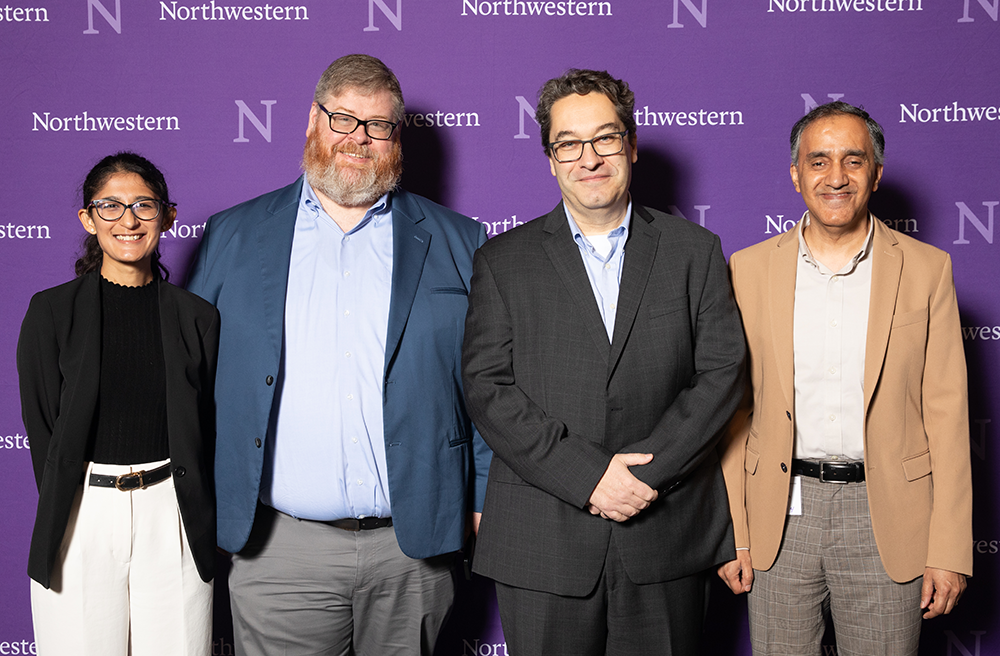
Hardavellas (second from right) at the Northwestern Quantum Leadership Networks event
The project draws from the consensus in the field that quantum phenomena can be more naturally simulated on a quantum computer than a classical system, which dovetails with important challenges in areas like materials science and pharmaceuticals.
“If you want to develop new therapies, and you want to understand exactly how certain chemical compounds’ molecules interact with each other; or if you want to develop better batteries—look at how lithiation works in batteries, this fundamental process of charging and discharging lithium ion batteries—you need to model the quantum dynamics of the system,” he says.
That’s extremely challenging using classical systems, Hardavellas says, requiring the use of supercomputers and, beyond relatively small problems, producing only approximated answers. Mapping such problems onto today’s quantum computers without specialized software and algorithms presents challenges of its own, requiring scientists who are experts not only in their scientific discipline but also in quantum computing itself, and, even more so, in the exact hardware they are trying to target.
“This impedes the ability of domain scientists to use quantum systems for their research,” he says. “It creates a high barrier of entry. So, this is exactly where we’re stepping in. We would like to remove this barrier. We would like to democratize, to the extent possible, access to those quantum machines for the domain experts.”
Lowering the barrier has involved developing a compilation infrastructure that simplifies the process for domain scientists. Researchers describe the system they want to study in a Hamiltonian—a mathematical representation of its behavior—and then input it into the compiler infrastructure, Hardavellas says.
“Then they just press a button. They don’t have to worry about what happens afterward,” he says. “We are making this process significantly easier for the domain scientists to model the systems on a quantum computer, without the need for them to become experts on either quantum computing or the exact hardware.”
The initial phase of the project will investigate how this process could work in pharmaceuticals, which is where AbbVie and Deloitte come into play, since they have projects examining how new molecules and compounds could lead to new therapies and new drugs, Hardavellas says. “And they can model the dynamics of the chemical processes that are taking place and interface with cells, as well. And through this compilation infrastructure, they will be able to run those simulations on a quantum system.”
Groups within those companies have expertise in chemistry, pharmaceuticals and quantum computing, and they will help Hardavellas and his team understand the Hamiltonians they want to target and the dynamics of the systems they want to model. “For the compiler to do a good job, we need to understand exactly what terms of the Hamiltonian you want to simulate are more important than others for the problem at hand,” he says. The compiler thus directs more resources to those more relevant terms, he adds.
Another strand of the project, which will involve dos Reis, a materials scientist, will examine Hamiltonians of interest in that area of science, such as battery development, for example, Hardavellas says. “Materials science also has lots of problems that could be mapped onto Hamiltonians that target execution on a quantum system,” he says. “What happens in polymers? What happens in alloys? What happens at the interface between two different compounds on a new material?”
IBM’s involvement will be to provide expert technical guidance, alongside significant compute time on the company’s large quantum systems in operation for a number of years, Hardavellas says. “They were kind enough to provide access to them, so the team could target real, high-end hardware that otherwise would be impossible to find,” he says. “We’re extremely lucky.
Ultimately, Hardavellas hopes not only to conduct research and develop a tool, but also to offer it as open-source software. “Then domain scientists around the world—in academia, industry, labs—could take it, use it, improve upon it,” he says. “The most important part is that we’re trying to step in and translate this research into something that has real impact in industry.”
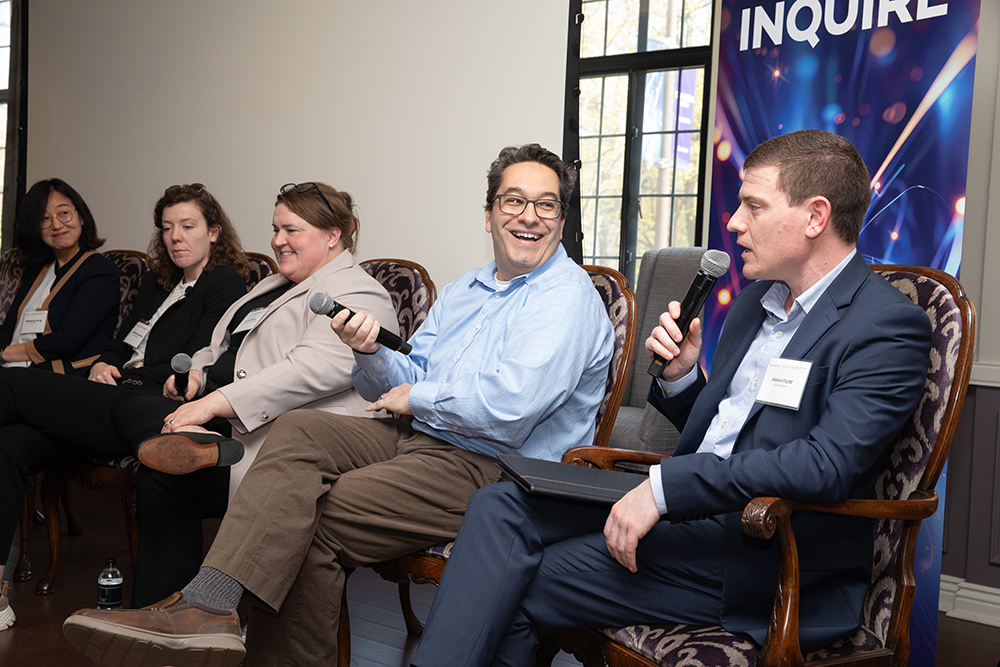
Hardavellas speaking at the Quantum Innovation Symposium, 2026