Alumni and Other Corporate Speakers Share Progress, Potential
During the INQUIRE Quantum Innovation Symposium, held on April 22 at Northwestern, an array of private-sector speakers from the quantum realm, including two Northwestern alumni, made a series of presentations and offered perspectives on the current status and future possibilities for their companies and the industry as a whole.
Alumnus Yuping Huang, CEO of Quantum Computing, Inc., said he’s outlined a future vision for 1 billion people using quantum computing. “It was a vision that was pretty scary for me to have proposed,” he said. “I have signed up for it, for [himself and] others who work at the company. … I firmly believe quantum will change the world.”
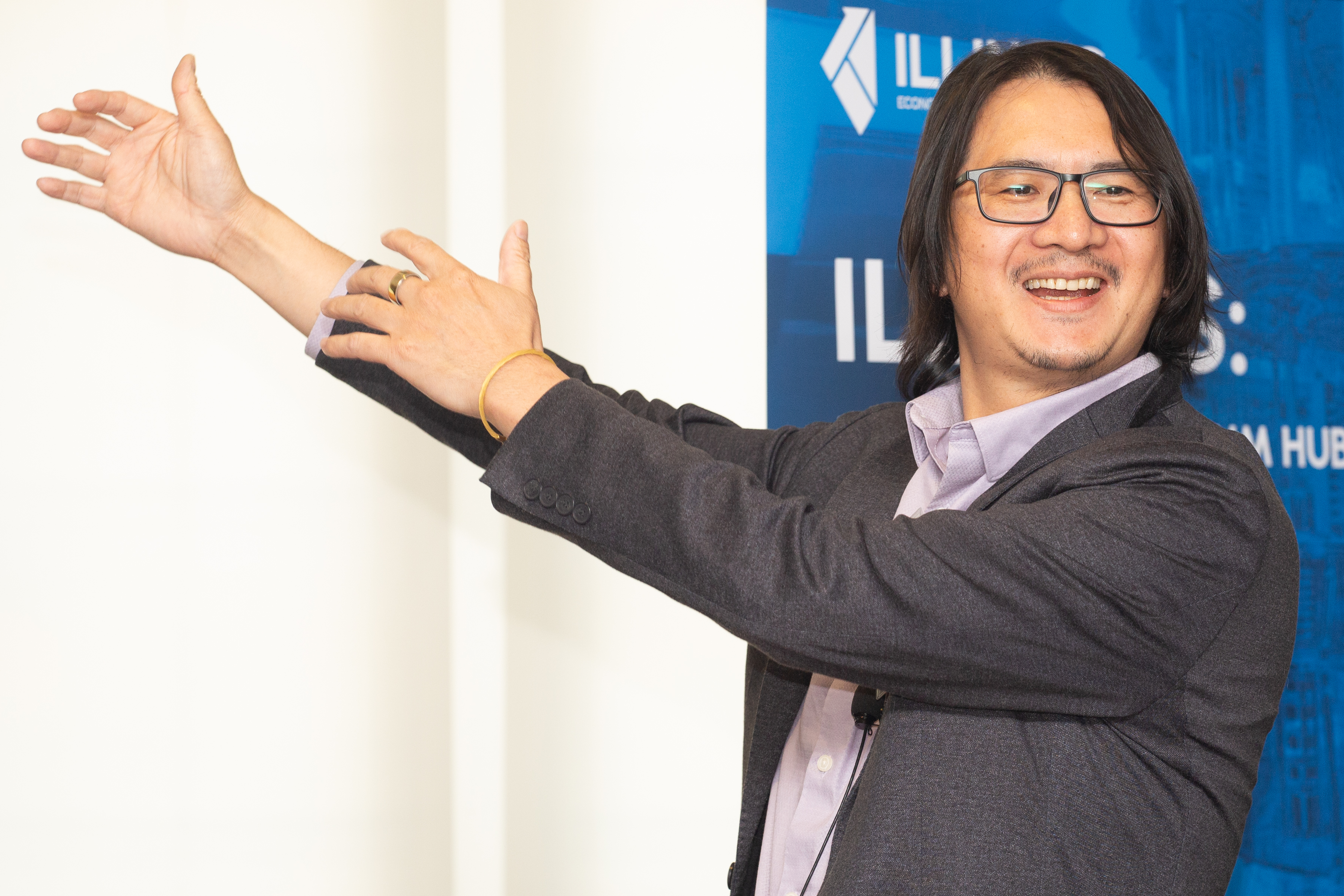
Huang acknowledged that vision will only become reality if quantum technologies eventually become affordable and accessible to the vast majority of people — a prospect some still view skeptically. Even so, he expressed confidence in the field’s long-term trajectory and emphasized a broader mission: moving quantum technologies beyond the lab and into the hands of everyday users.
Across its seven facilities, Quantum Computing, Inc., is working in multiple quantum verticals, said Huang, a Northwestern post-doctoral researcher from 2009-11, research associate from 2011-12 and research assistant professor from 2013-14. “I’m excited about the research progress we have made in our labs. But what we are looking to do now is to establish the platform for the ecosystem,” he said.
Alumnus Johannes Pollanen, who received a PhD in physics in 2012, co-founder and chief scientific officer of Chicago-based EeroQ Corporation, discussed his company’s “unique and novel platform for quantum computing,” based on the spins of electrons trapped above the surface of liquid helium that can be used as qubits. That concept of using these electrons as qubits has been around for a while and was first proposed by a colleague of Pollanen’s at Michigan State University, where he is a professor in the Department of Physics and Astronomy.
Pollanen explained that EeroQ’s platform uses electrons trapped in liquid helium to create qubits, each with distinct advantages and limitations. Charge-based qubits are easier to control and connect, while spin qubits may offer dramatically longer coherence times, a critical consideration for scalable quantum computing. “That’s why we’re really focusing on spin qubits at EeroQ,” he said.
EeroQ has a 10,000 square foot R&D facility in Humboldt Park in Chicago and also uses the advanced cryogenic testing capabilities at the mHub in Chicago, Pollanen said. “To get this idea that’s been around for a while off the ground, what we realized is that we had to bring all of the experts in the world working on electrons in helium together to build this company, and then to really put our foot on the accelerator,” he said.
The work of EeroQ’s theory team that thinks about decoherence and device design feeds into their device design team, which creates structures fabricated in-house or commercially with partners. Then, their engineering team does the cryo-testing all in a tight feedback loop to build EeroQ’s next generation quantum computer. “We have a really fantastic team,” he added.
Abhinav Kandala, principal research scientist at IBM Quantum, said that while quantum mechanics has enjoyed tremendous success, the exact applications of its laws have been challenging to determine. However, much of this success has been driven by trust-building with approximate classical methods, even in the absence of exact solutions, he said.
“Can you begin to play this game with a quantum computer?” Kandala said. “You need devices that scale beyond what you can do with brute force classical computation because if you didn’t, why don’t you just do the computation on classical? … Over the last several years, we’ve had devices with qubit counts beyond 65, and this already places us, with such machines, where the devices are beyond this trivial scale.”
However, secondly, those devices need to produce trustworthy results. “What’s the problem there?” he said. “The error rates for a qubit in a quantum computer are well over 10 orders of magnitude than the error rates of a transistor in a classical computer.”
The only known long-term solution is fault-tolerant quantum computing, which IBM hopes to build before the end of the decade, Kandala said. However, with methods such as error mitigation, he said that pre-fault tolerant quantum processors can already produce trustworthy results at scales beyond brute force classical computation. To keep tabs on the “race” between classical and quantum computing, IBM and partners have created the open-source “Quantum Advantage Tracker” to which it and other companies and researchers are contributing their potential solutions, with an emphasis on validation of the quantum result, he said.
Elena Glen, quantum computing lab manager at Quantum Machines, a global company headquartered in Tel Aviv, said her firm is building a quantum computing center in Chicago, with labs at the mHub, fridges under installation this spring and QPUs accessible from the cloud by the end of the year.
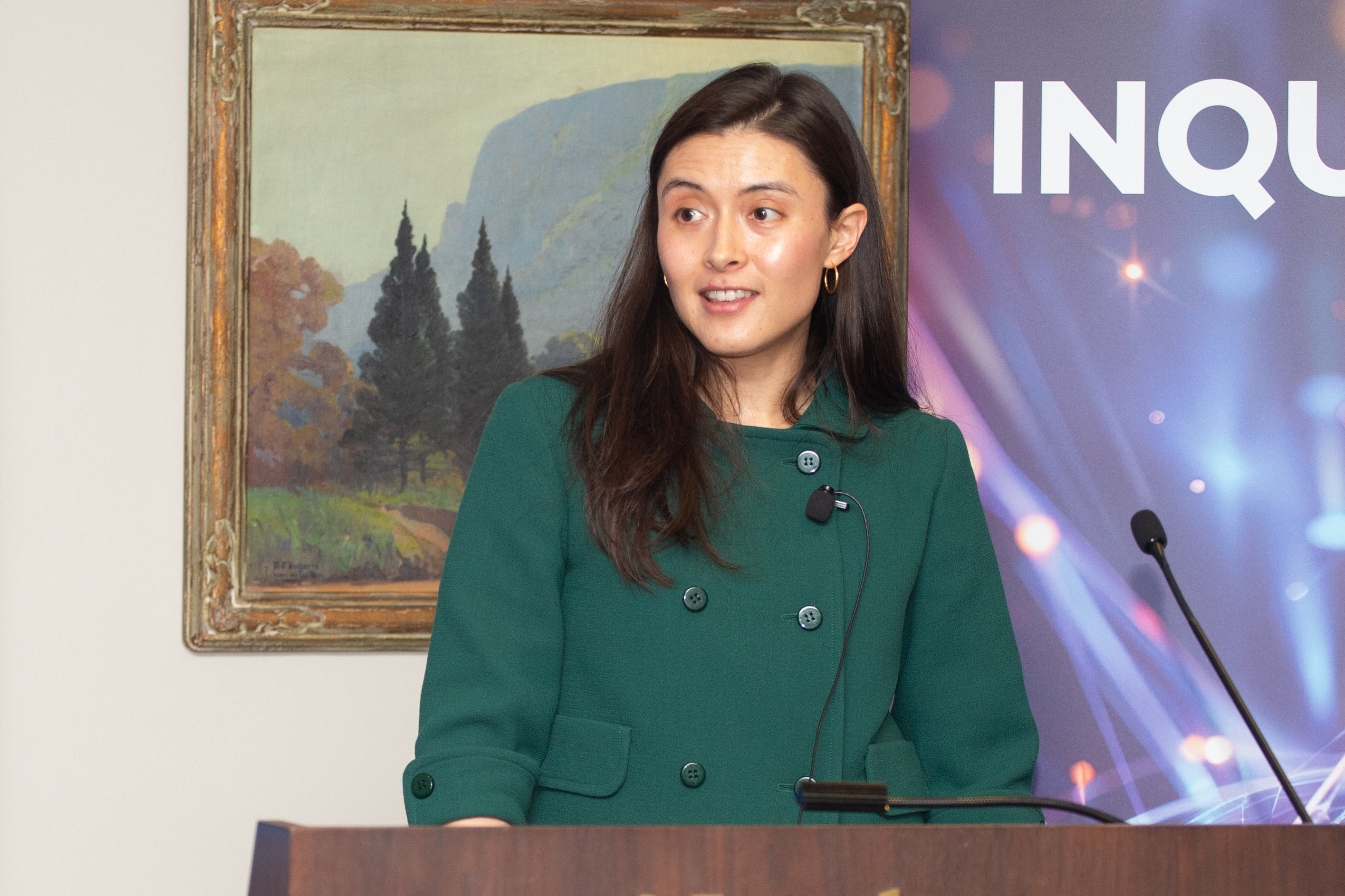
If those QPUs are the biceps of quantum computing, Quantum Machines “is in the business of making the brains that orchestrate and execute quantum algorithms on QPUs,” Glen said. “We are developing the control layer to also include classical compute resources needed to do things like quantum error correction, to do rapid calibrations, machine learning routines and adaptive experiments. All at very low latency to perform what we call classically accelerated quantum classically accelerated quantum supercomputing. We refer to this concept as hybrid quantum-classical control.”
The company builds a flagship controller that supports all qubit modalities, sends and receives digital pulses to control qubits, “measures and processes signals that come back, and it can react in real time based on the measurement outcome,” Glen said. “And all of this happens at very low latency on … nanosecond time scales.”
Caitlin Carnahan, vice president for quantum software at Infleqtion, Inc., a neutral atom quantum computing and quantum sensing company, talked about how abstraction layers have enabled her company and others to build “ever-more-capable computing devices,” with applications at the top level, hardware at the bottom and what Northwestern Professor Nikos Hardavellas wryly refers to as “the bag of stuff in between.”
Quantum computers work similarly to classical ones in that regard, Carnahan said, noting that it’s taken 80 years to build up layers of abstraction in classical computing. “When people ask you, ‘What can you do with a quantum computer, where are the cutting edge applications? Where are they going to exceed what we can do classically?’, it's important to keep in mind that as an industry, we’ve made significant progress, but there is still a lot of work to do,” she said. “We need to keep building on that momentum.”
Infleqtion, like Huang’s company, wants to move forward as quickly as possible with its quantum stacks, Carnahan said. “We want to be pretty aggressive about getting these solutions out into the hands of users,” she said.
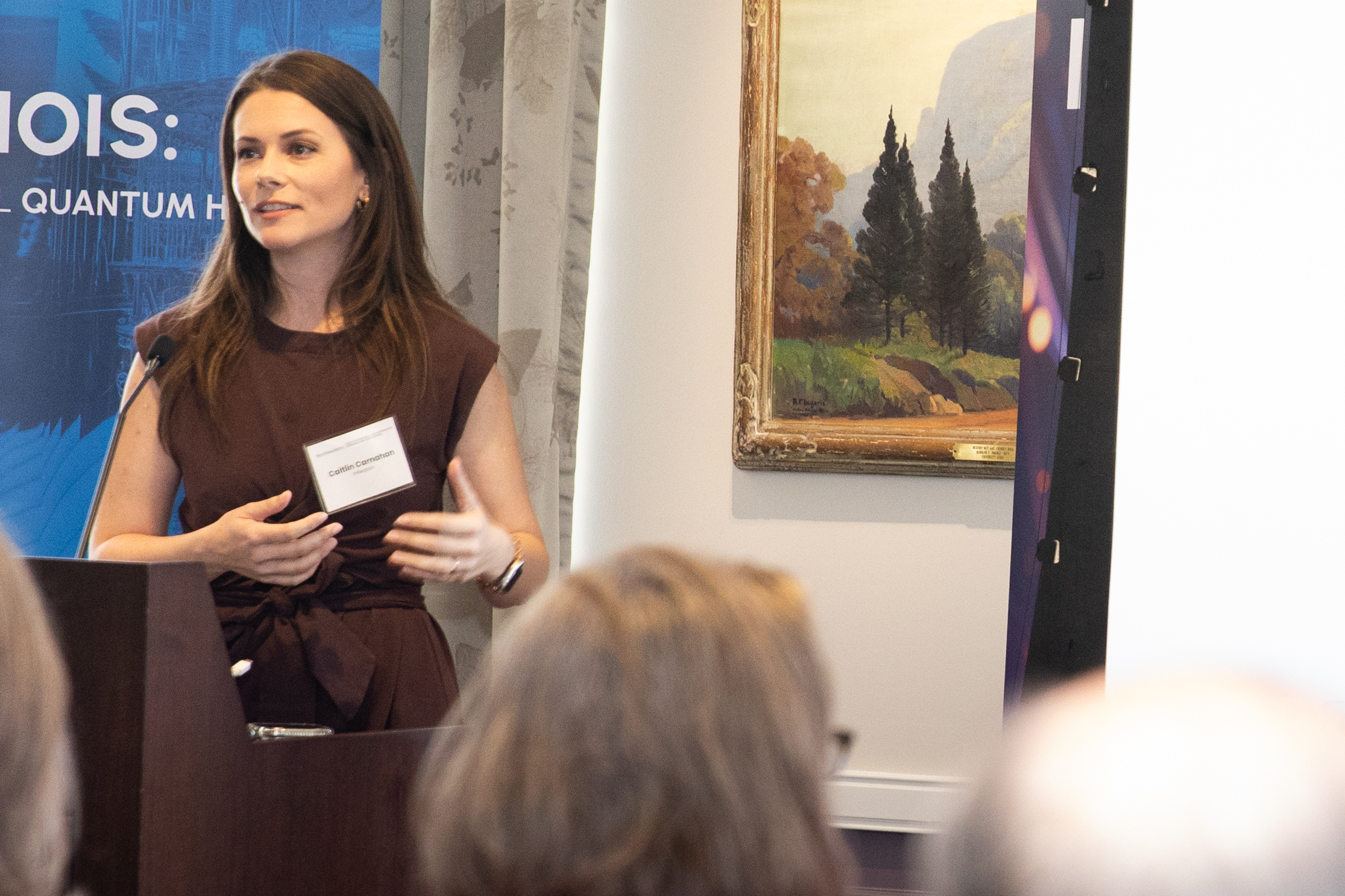
However, she added, “Moving from that beautiful experiment in a pristine lab into a system that could work on the ground, or in the sea, or in the air, or in space, that's an incredibly challenging problem. It requires packaging, it requires control systems. It requires calibration, it requires reliability, it requires software, it requires manufacturability, and it requires the ability to integrate into other systems. So we're not just putting it out there, and it's sitting on its own.”
Among other projects, Infleqtion has deployed neutral atoms, which Carnahan called “nature’s perfect qubits,” to a customer in partnership with University of Chicago Pritzker School of Medicine and MIT focused on biomarker discovery for precision oncology. “Finding the optimal set of clinically informative features that can serve as your biomarkers for a particular task is a computationally intractable problem,” she said, and the effort focused on using the quantum computer “to help give the classical methods a boost.”
“This was a massive effort by a huge team,” Carnahan added. “What I really, really love about this collaboration is that it wasn’t just quantum algorithms researchers. It wasn’t just quantum compilation experts. It was practicing oncologists, it was computational biologists, it was geneticists, it was people who they understand what it would mean to have advantage on this problem. … We go to the experts, we go to our eventual end users, and we ask them to help us find those problems and help us evaluate the solutions that we're putting forward.”