Bringing Quantum Computer Cybersecurity Research to Northwestern
We want to build a community where anybody can come in, and you don’t have to be part of some society, or pay registration”
— Jakub Szefer
Associate Professor of Electrical and Computer Engineering
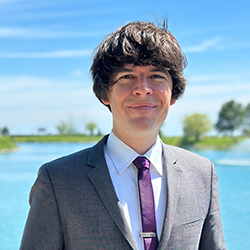 Jakub Szefer
A recent symposium organized by a new faculty member convened academia, industry, and government.
The third annual Quantum Computer Cybersecurity Symposium (QCCS), held November 6-7 at The Guild Lounge at Scott Hall, was the brainchild of recently arrived electrical and computer engineering Professor Jakub Szefer, who hosted the first two iterations of the event at his former position at Yale University before joining Northwestern in January 2025.
The symposium arose out of Szefer’s recent research strand focused on the security aspects of quantum computing, although his general interest in cybersecurity dates to his graduate school days at Princeton University, where he received a PhD in electrical engineering; during that time, his emphasis was more on hardware security and classical computer architecture.
“Since then, my research has encompassed architecture security, hardware security, anything that involves computer architecture or computer hardware, but also that involves cloud computing,” Szefer says. “The research tries to understand, from an electrical perspective and from a computer architecture perspective, what are the different security vulnerabilities and how to mitigate them. … The fun part is finding the problems, but the end goal is to actually design effective protections that can be implemented and make computing safer.”
Within the past five or six years, Szefer began homing in on quantum computing, motivated by the fact that starting with IBM’s five-qubit machine in about 2016, quantum computers have become accessible online through the cloud. “Although a five-bit quantum computer doesn’t really do anything, still, it’s a physical device that you can access over the internet,” he says.
Szefer’s research has since gone in two directions, examining firstly how, if multiple users submit jobs to be executed on a remote quantum computer, they can be protected from one another. “You never know who the other people are that you’re executing along with,” he says. Secondly, he’s looked at “how to protect the users from the cloud provider, or the quantum computer provider. When you submit your circuit or your data, how do you ensure that the intellectual property is protected, or the confidentiality of any sensitive information is protected?”
While there’s no reason to necessarily think that cloud and quantum computer providers are malicious, Szefer still believes it’s important to put mechanisms in place. “I don’t think anybody at Northwestern is malicious, but I still lock the door to my office, right? It’s kind of the same idea,” he says. “We want to have some mechanism to prove or to show that the computation is protected,” especially now that machines have grown from five to somewhere between 100 and 200 qubits, and many larger architectures are expected soon. “As the systems get bigger, more and more people want to use them. And as they start to use them for really sensitive computations, how do you protect them?” he adds.
When Szefer started QCCS two years ago, his motivation was to fill a gap between the many quantum computing conferences and equally many cybersecurity conferences. “Nothing really focused on the intersection of those two areas,” he says. So he aimed “to bring in researchers that are looking at quantum computing but are interested in security, and security researchers that are interested in quantum computing, bring them together and have a venue.”
The conference has grown each year in the number of attendees and the length—from a half-day in 2023, to a full day last year, to two days this year, Szefer says, adding that it’s intended to be more informal than a typical academic conference.
“The community has grown,” he says. “There’s no publications or proceedings. Every talk is only about 15 minutes … to share the highlights of research, something interesting. Since there are no research papers and no recordings, hopefully people are motivated to talk about their most recent results. It’s more to stimulate discussion in a friendly atmosphere, to share what you’re working on.”
Another purpose for the event is to highlight the fact that quantum cybersecurity is not the same concept as post-quantum cryptography, which is aimed at protecting against outbound cyber-attacks emanating from quantum computers themselves, Szefer says.
“While post-quantum cryptography is, of course, a very important topic—it’s actually another topic that we’re researching, in parallel—it’s actually totally different from the cybersecurity of quantum computers, where you’re trying to protect the quantum computer from the attacks. … How do you modify the quantum computer to provide more security features, so the confidentiality of the user circuits is protected, for example?”
Szefer figures that most researchers are focusing on that aspect. “It’s a cloud-based system now, so it’s easily accessible by random people, that you don’t know what they’re doing,” he says.
Most speakers at QCCS were from academia, including international universities. The keynote was to be delivered by Dr. Dilma Da Silva, division director at the National Science Foundation as well as a professor at Texas A&M University, although the government shutdown prevented it from happening, and additional talks were given in its place. Both the dean of the McCormick School of Engineering and the chair of the electrical and computer engineering department gave insightful introduction on the first and second day of the event, respectively. Attendees predominantly were graduate students and faculty, while some industry and government representatives attended as well, Szefer says.
The Northwestern Institute for Quantum Information Research and Engineering (INQUIRE) co-organized the conference, and corporate sponsors included IonQ, Belden, Schneider Electric and qBraid. Attendance was free. “We want to build a community where anybody can come in, and you don’t have to be part of some society, or pay registration,” Szefer says. “It’s really nice to see that the university is providing a lot of support for this.”
The first year QCCS was held, the majority of attendance was remote, but Szefer says this year around two-thirds of speakers appeared in person. Thanks to generous industry sponsorship, travel reimbursement was possible for student speakers for the first time this year, and Szefer hopes that in 2026 and future years, the in-person attendance will dominate the event. Given the momentum behind quantum computing in the Chicago area, as seen in the recent groundbreaking for the Illinois Quantum and Microelectronics Park, QCCS can create an unique venue for research at intersection of quantum computing and security, according to Szefer.
Informal discussions are key to any academic and industry collaboration and research, and “we had student, faculty and industry dinners on both Thursday and Friday,” he says, to foster further opportunity for participants to connections. “Our hope is that there’s more chance for in-person interaction. This year, definitely we had the biggest sponsorship from industry, so it hopefully also means that a lot of the industry supports this effort. […] Industry is focusing on making things better, and faster, and bigger, which of course they have to. But in parallel, hopefully they can also work on security, connecting with everybody at the symposium.”
Szefer already looks forward to the next QCCS and bringing together an even bigger crowd of students, researchers and industry to tackle the critical research topics of security and quantum computing.